"L-theanine caffeine ratio" is a search a lot of gamers land on after noticing that some energy products pair the two on purpose. The short version is that a handful of published studies have looked at combining L-theanine and caffeine, most using more theanine than caffeine, and found effects on attention and alertness that neither ingredient produced as strongly alone. Below is what those studies actually tested, at what doses, and what that does and doesn't tell you about any specific product, including ours.
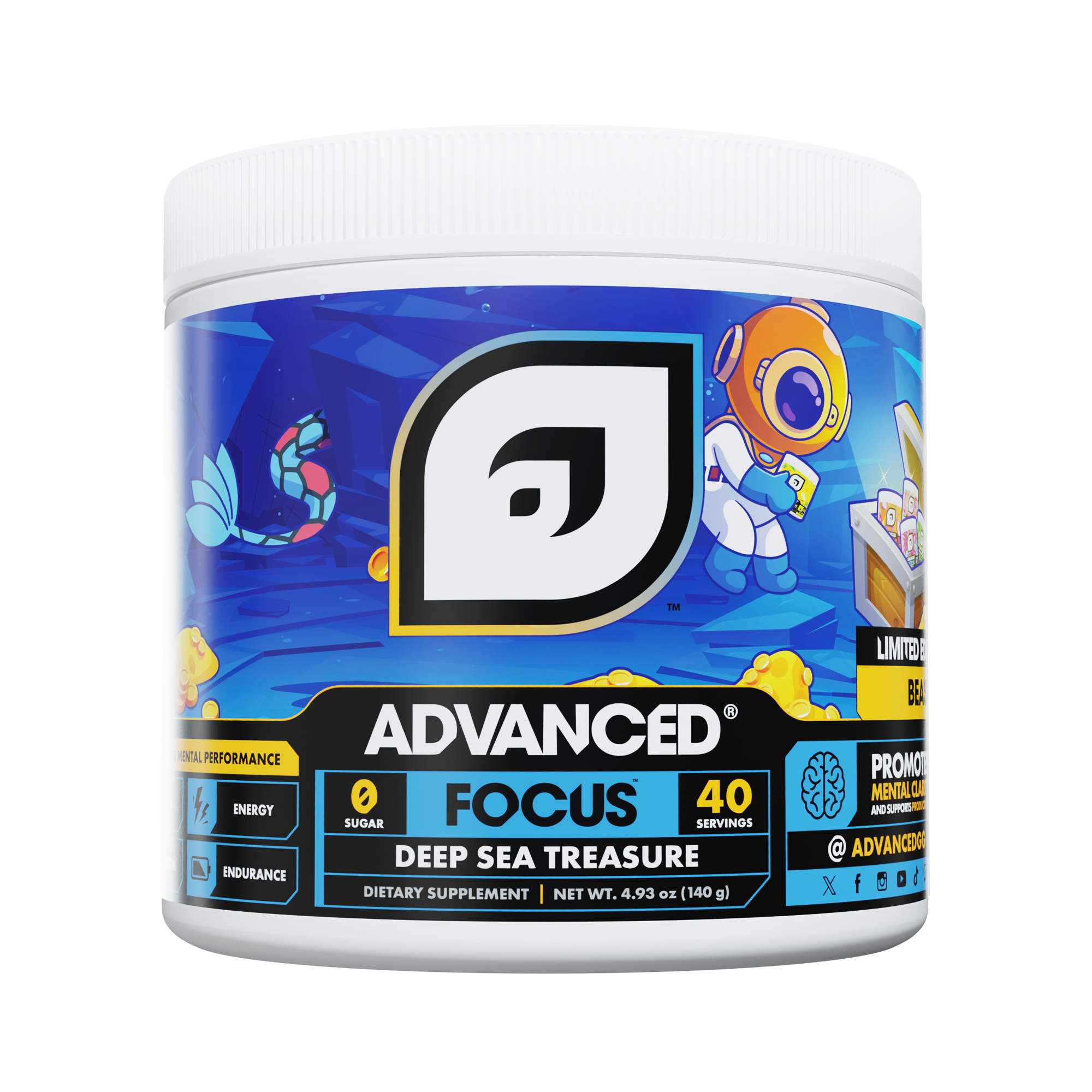
We're ADVANCED®, and our Energy and standard FOCUS formulas both pair natural green tea caffeine with L-theanine. We want to be precise about something up front: the research below is on the ingredient combination in general, run by independent researchers on their own dosing, not a study of ADVANCED's product. We have not run our own clinical study on our formula, and we're not going to imply otherwise.
What is the L-theanine to caffeine ratio studied in research?
The most commonly cited studies used a L-theanine to caffeine ratio near 2:1, meaning about twice as much L-theanine as caffeine by weight. One trial used 97 mg L-theanine with 40 mg caffeine, close to 2.4:1, and another used 100 mg L-theanine with 50 mg caffeine, a clean 2:1 ratio.
Both of those studies found measurable effects on attention and alertness compared to placebo, which is where the "roughly twice as much theanine as caffeine" framing you'll see referenced elsewhere comes from.
That 2:1-ish range isn't a hard rule, it's just where the two most-cited positive trials landed. A separate study using less theanine than caffeine (50 mg theanine to 75 mg caffeine) found the combination did not reliably outperform caffeine alone, which suggests the ratio, not just the presence of both ingredients, may matter for the effects researchers have measured.
The research: three studies, three different doses
Owen et al., 2008, Nutritional Neuroscience. Researchers compared 50 mg caffeine alone against 50 mg caffeine plus 100 mg L-theanine (a 2:1 theanine to caffeine ratio) in 27 healthy adults, using word recognition, visual processing, and attention-switching tasks. The combination improved both speed and accuracy on the attention-switching task and reduced how much participants got thrown off by distracting information, effects that caffeine alone didn't fully produce. Read the study: pubmed.ncbi.nlm.nih.gov/18681988.
Giesbrecht et al., 2010, Nutritional Neuroscience. This trial tested 97 mg L-theanine with 40 mg caffeine (roughly 2.4:1) against placebo in 44 young adults. The combination significantly improved accuracy during a task-switching test and increased subjective alertness while reducing self-reported tiredness, compared to placebo. Read the study: pubmed.ncbi.nlm.nih.gov/21040626.
Dodd et al., 2015, Psychopharmacology. This study used lower, tea-like doses, 75 mg caffeine and 50 mg L-theanine (less theanine than caffeine, roughly a 0.67:1 ratio), and looked at cerebral blood flow alongside cognition and mood. At this dose and ratio, the reaction-time and mood benefits seen with caffeine alone were not preserved when L-theanine was added, a notably different result from the two studies above. Read the study: pmc.ncbi.nlm.nih.gov/articles/PMC4480845.
L-theanine and caffeine studies at a glance
| Study | Caffeine dose | L-theanine dose | Ratio (theanine:caffeine) | What it found |
|---|---|---|---|---|
| Owen et al., 2008 | 50 mg | 100 mg | 2:1 | Faster, more accurate attention-switching; less distractibility vs. caffeine alone |
| Giesbrecht et al., 2010 | 40 mg | 97 mg | ~2.4:1 | Better task-switching accuracy; higher alertness, lower reported tiredness vs. placebo |
| Dodd et al., 2015 | 75 mg | 50 mg | ~0.67:1 | Reaction-time and mood benefits from caffeine alone were not preserved with theanine added |
Three studies is not a settled scientific consensus, and dose, ratio, and the specific tasks measured all varied between them. What's consistent across the two positive trials is that they both used meaningfully more L-theanine than caffeine, not less.
Does more L-theanine always mean better focus?
Not necessarily, and the research doesn't support that as a blanket rule. The two studies that used roughly twice as much L-theanine as caffeine found measurable benefits on attention and alertness, while the study using less theanine than caffeine did not replicate those benefits at its lower, tea-equivalent doses.
That gap between studies is worth taking seriously rather than smoothing over. It's possible the ratio matters, it's possible the absolute dose matters, and it's possible individual factors like caffeine tolerance play a role that a single lab study can't fully capture. The honest summary is that the combination has shown positive results in more than one independent trial at a roughly 2:1 theanine-heavy ratio, but it isn't a guaranteed effect at every dose or ratio tested.
Why brands pair L-theanine with caffeine at all
The stated rationale in most of this research, and the reason a lot of energy products use the pairing, is that L-theanine may help take the edge off caffeine's stimulant effects, the jittery or overstimulated feeling some people get, without necessarily blunting the alertness caffeine provides. That's a structure and function idea grounded in what these specific trials measured (attention, alertness, self-reported jitteriness), not a claim that the combination treats or prevents any condition, and it's not guaranteed to play out the same way for every person or every product.
What ADVANCED actually uses, and what we're not claiming
ADVANCED Energy pairs 100 mg of natural green tea caffeine with L-theanine, along with L-taurine, magnesium citrate, and potassium citrate, all listed at exact amounts for both a one-scoop and two-scoop serving on our Energy product pages. Our current FOCUS line is caffeinated. Product pages that state the caffeine amount identify 100 mg of natural green tea caffeine per serving; check each current label for the complete formula and exact amounts.
We're not going to tell you our exact L-theanine dose lines up with any specific study above, or that our formula has been clinically tested, because neither of those things is true. What we can tell you is that we use the same two ingredients, caffeine and L-theanine, that the research above has studied in combination, and you can see the exact amount of each on our label rather than a blend total. If the specific milligram ratio matters to your own decision, check the current label on the product page directly, since that's the only place we're willing to state it precisely.
How this compares to other gaming energy products
Most gaming energy powders pair caffeine with some form of L-theanine or a broader nootropic blend, though not all of them disclose the exact amount of each. Some brands fold L-theanine into a named complex alongside several other ingredients and publish only the combined total, which makes it impossible to know the actual ratio you're getting. Others state a ratio directly on their ingredients page. Checking whether a brand lists L-theanine's exact milligram amount, rather than just its presence on the ingredient list, is the most useful thing to look for if this specific combination is why you're buying.
Is L-theanine and caffeine good for gaming?
There is no research specifically on gaming performance as an outcome, but the published studies on attention-switching, sustained attention, and self-reported alertness are relevant to the kind of focus long gaming sessions demand. Multiple trials at a theanine-heavy ratio found real effects on those tasks versus placebo or caffeine alone.
Results were not consistent across every dose tested, though, and no study measured anything resembling actual game performance directly. Treat the research as relevant background, not a guarantee.
Whether that translates to a noticeably better gaming session for any individual person depends on factors no lab study can fully account for, including your own caffeine tolerance, how much sleep you've had, and what you're playing. The research supports the ingredient pairing as a reasonable, well-studied approach, not a guaranteed outcome.
How much L-theanine should I take with caffeine?
The two studies that found positive effects used roughly 100 mg L-theanine with 50 mg caffeine, and 97 mg L-theanine with 40 mg caffeine, both landing close to a 2:1 theanine-to-caffeine ratio. That's a reasonable reference point, not a required dose, since a third study at a lower, less theanine-heavy ratio did not find the same benefits.
If you're checking a specific product against this research, look at the label for the exact milligram amount of both caffeine and L-theanine rather than assuming a "theanine included" claim means a particular ratio. Brands that list exact doses, including ours, make that comparison possible; brands that use a blend total don't.
Does ADVANCED Energy contain L-theanine and caffeine together?
Yes. ADVANCED Energy uses 100 mg of natural green tea caffeine paired with L-theanine, both listed at exact amounts on the label for one and two scoop servings, alongside L-taurine, magnesium citrate, and potassium citrate. Nothing here is folded into an unnamed blend.
You can see the current label details on our products page, and read verified customer reviews on each product page before deciding.
Bottom line
The research on L-theanine plus caffeine is real, peer-reviewed, and mostly positive at ratios where L-theanine outweighs caffeine, roughly 2:1 in the two studies that found benefits, though a third study at a different, lower ratio didn't replicate those results. None of it is a study of any specific commercial product, ADVANCED included. What we can tell you honestly is that we use the same two ingredients this research has studied, at exact doses we publish on the label rather than folding them into a blend, and you're welcome to check that label against the studies above yourself.