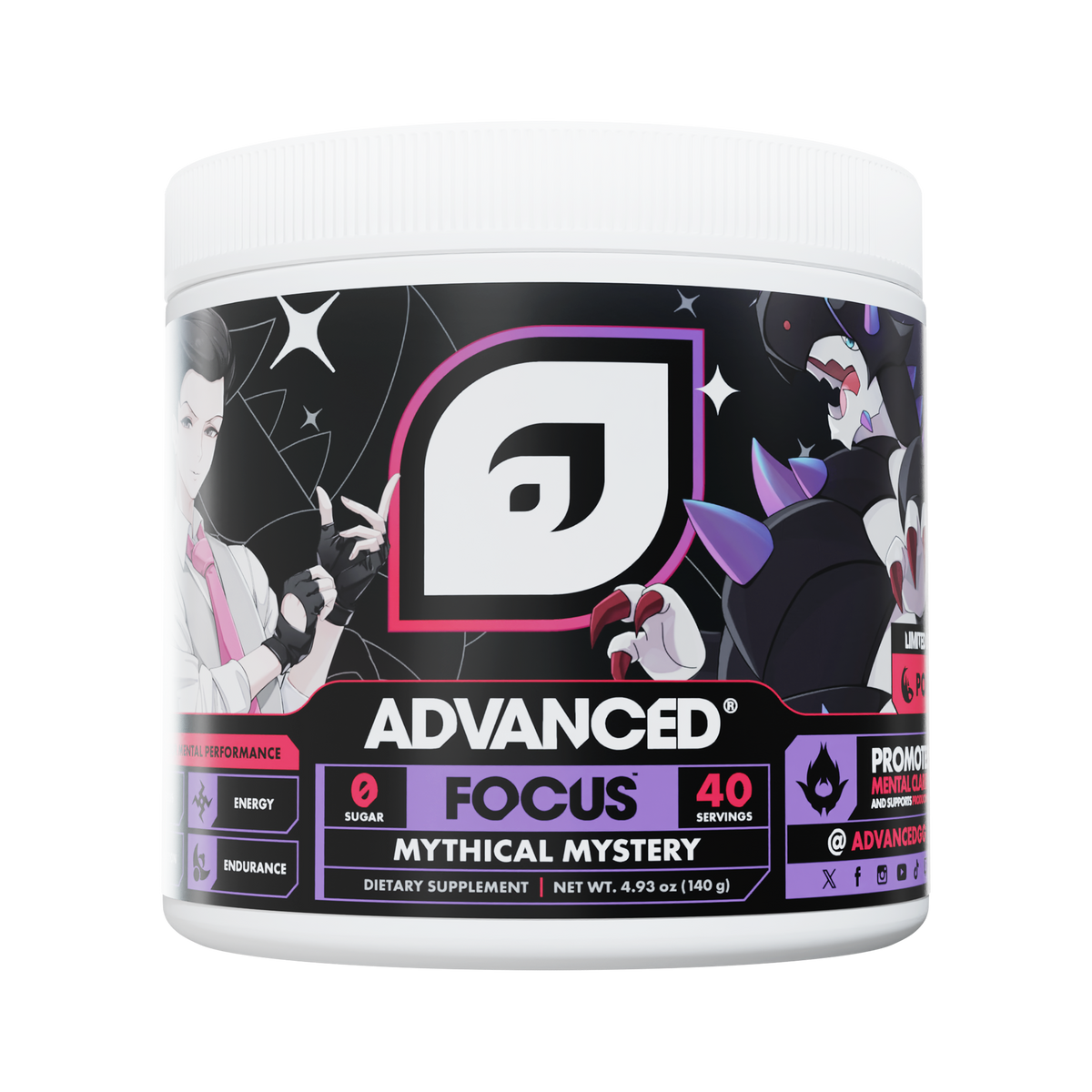
ADVANCED FOCUS jar showing the open label with L-Arginine HCl and Myo-Inositol

L-Arginine HCl and Myo-Inositol for Gaming Focus, Explained

We break down the actual published research on L-Arginine HCl and Myo-Inositol, what it does and doesn't show, and why ADVANCED uses both in FOCUS.
Best Caffeine-Free Gaming Drinks in 2026 Reading L-Arginine HCl and Myo-Inositol for Gaming Focus, Explained 10 minutes Next Best Energy Drink for Streaming and Creators (2026)

If you've read the label on our FOCUS line, or on the caffeine-free version specifically, you've seen L-Arginine HCl and Myo-Inositol listed as the core actives. These aren't ingredients you'll see discussed much in gaming content, which is part of why we wanted to actually lay out what the published research says about them, plainly, instead of just putting them on a label and letting the names do the marketing.

We're ADVANCED®, and we sell a product that contains both of these ingredients, so keep that in mind as you read. We're not going to tell you our formula has been clinically tested, because it hasn't, what follows is a summary of research on the individual ingredients, done by independent researchers in populations and doses that are often different from what's in our product or how you'd use it for gaming. We've linked to the actual studies so you can read them yourself rather than take our summary at face value.

What is L-Arginine HCl?

L-Arginine is a semi-essential amino acid, meaning your body can make some on its own but may need more from diet or supplements under certain conditions. The "HCl" denotes the hydrochloride salt form, which is more water-soluble and shelf-stable than plain L-arginine, a common reason supplement makers use the HCl form in powders. In the body, L-arginine is a direct precursor to nitric oxide, a molecule that relaxes blood vessels and increases blood flow, which is the primary mechanism researchers point to when studying its effects on the brain and elsewhere.

What is Myo-Inositol?

Myo-inositol is a naturally occurring carbohydrate, technically a sugar alcohol, that your body produces and that's also found in foods like citrus fruits, beans, and whole grains. It isn't a stimulant. Its role in the body is as a precursor for inositol phospholipids, molecules involved in cell signaling, including signaling tied to serotonergic and cholinergic neurotransmitter systems, the same broad systems involved in mood regulation and attention. It's most established in research contexts related to mood and hormonal health rather than as a studied "focus" ingredient on its own.

Has L-Arginine been studied for cognitive function?

Yes, though the research base skews toward older adults with existing health conditions rather than healthy young adults. A 2022 randomized, placebo-controlled study published in Frontiers in Cardiovascular Medicine gave 72 frail, hypertensive elderly patients (average age around 77) either a branded oral L-arginine product (1.66 grams, twice daily) or placebo for four weeks. The L-arginine group showed a statistically significant improvement in Montreal Cognitive Assessment scores compared to placebo (p=0.0178). The researchers proposed the mechanism runs through L-arginine's role in nitric oxide production and reduced oxidative stress in blood vessels. It's worth being direct about what this study doesn't tell you: the population was elderly and hypertensive with existing cognitive impairment, the sample was small, the follow-up was short, and the study doesn't specify whether the branded product used was the HCl salt form specifically. None of that makes the finding meaningless, but it means you shouldn't read "improves cognition in gaming" into a study of frail elderly patients with high blood pressure.

What about arginine paired with inositol specifically?

This is where the research gets more directly relevant to a focus-and-gaming context, but it also requires an important caveat. Two published, randomized, placebo-controlled crossover studies tested inositol-stabilized arginine silicate, sold under the brand name Nitrosigine, in healthy, physically active young adult males. Both studies used the Trail Making Test, which measures processing speed and executive function. Across a 1,500 mg daily dose, one study found a 28 percent faster completion time on the more complex portion of the test after 14 days, and a related study found 33 to 35 percent faster completion within days of starting supplementation. A separate 2021 study on the same compound, this time in 19 young adults with a 63 percent female cohort, found an 11 percent increase in total score on a standardized neuropsychological battery (RBANS) and a 27 percent increase in immediate memory performance an hour after a single dose, compared to placebo.

Here's the caveat that matters: inositol-stabilized arginine silicate is a specific, patented, chemically bonded complex of arginine, silicon, inositol, and potassium. It is not the same thing as separately supplementing plain L-Arginine HCl and plain Myo-Inositol, which is what's actually in ADVANCED FOCUS. The two ingredients share a name-level overlap with what's in this bonded compound, but bonding two actives into a single silicate complex can change how they're absorbed and how they behave in the body compared to taking each one on its own. We're not aware of published research testing plain L-Arginine HCl and plain Myo-Inositol together as separate ingredients, for gaming focus or otherwise. If you want to look into arginine silicate specifically, it's worth knowing that's a materially different product than most arginine or inositol supplements on the market, ours included.

Has Myo-Inositol been studied for mood or mental performance on its own?

The most-cited human trial on myo-inositol and a brain-related outcome is a 1995 double-blind, placebo-controlled crossover study published in the American Journal of Psychiatry, involving 21 patients with panic disorder. Patients received 12 grams of inositol per day for four weeks, and researchers found a significant reduction in the frequency and severity of panic attacks compared to placebo, with minimal reported side effects. That's a substantial dose, well above what you'd find in a single scoop of most supplements, and the population was patients with a diagnosed psychiatric condition, not healthy gamers looking for sharper reaction time. Separately, researchers have observed that cerebrospinal fluid myo-inositol levels tend to run lower in people with affective disorders, and that the compound is a precursor for phospholipids tied to serotonergic and cholinergic signaling, which is the mechanistic reasoning behind interest in inositol for mood and cognitive research generally. None of this is a study of inositol's effect on reaction time, attention span, or gaming performance specifically, and we haven't found one that is.

Does any of this mean ADVANCED's formula is clinically proven?

No, and we want to be direct about that instead of letting the studies above do more work than they should. ADVANCED FOCUS, as a finished product, has not been clinically tested. The research summarized here is on individual ingredients, studied independently by outside researchers, often at different doses, in different forms, and in different populations than what's in our product or how you'd realistically use it during a gaming session. Nitrosigine research doesn't transfer directly to plain L-Arginine HCl and plain Myo-Inositol. The elderly hypertensive study doesn't transfer directly to a healthy adult gamer. The panic disorder study used a dose several times higher than what's practical in a flavored powder. We're including all of this because it's the honest, verifiable research that exists around these two ingredient names, not because we're claiming it proves our specific product does anything in particular.

Why did ADVANCED choose these ingredients?

We chose L-Arginine HCl and Myo-Inositol for FOCUS, particularly the caffeine-free version, because they're genuinely non-stimulant options with a real, if still developing, research base behind their individual mechanisms, nitric oxide-mediated blood flow for L-arginine, and neurotransmitter-linked signaling for myo-inositol, rather than because either one is a proven performance enhancer on its own. Alpha GPC rounds out the caffeine-free formula as a third non-stimulant nootropic ingredient. If you want the version with caffeine, standard FOCUS adds 100 mg of natural green tea caffeine, L-theanine, and ginseng to that same base. Every ingredient across both versions is listed individually with its exact dose per scoop, not folded into an unnamed blend, so you can look up any one of them yourself the way we did here. You can see the full label for every FOCUS flavor on our products page, browse the FOCUS collection directly, check verified customer reviews on each product page, and see more ingredient questions answered on our FAQ page.

Is L-Arginine HCl the same as the arginine silicate used in Nitrosigine studies?

No. L-Arginine HCl is the hydrochloride salt form of the plain amino acid. Arginine silicate is a different, patented compound that chemically bonds arginine with silicon and inositol into a single complex. The two are related by sharing arginine as a base ingredient, but the research on one doesn't automatically apply to the other, since bonding can change absorption and effects.

What dose of these ingredients has actually been studied?

It varies a lot by study and isn't the same as what's in a single scoop of any commercial gaming supplement, including ours. The L-arginine cognition study in elderly patients used 3.32 grams a day split into two doses. The Nitrosigine studies used 1.5 grams a day of the bonded compound. The myo-inositol panic disorder study used 12 grams a day. We list our own exact per-scoop amounts on each product label rather than here, since the point of this article is the independent research, not a claim about matching those doses.

Bottom line

L-Arginine HCl and Myo-Inositol both have real, published research behind them, but that research is scattered across different populations, different doses, and in one major case, a chemically different bonded compound rather than the plain ingredients themselves. Read carefully: a study on frail elderly hypertensive patients, a study on a patented arginine-silicate-inositol complex in healthy young adults, and a study on high-dose inositol for panic disorder are all real and verifiable, but none of them is a study of "L-Arginine HCl and Myo-Inositol taken together for gaming focus," because as far as we could find, that specific study doesn't exist yet. We think the individual mechanisms are interesting enough to build a caffeine-free product around, and we'd rather tell you exactly what is and isn't established than oversell it.