Streaming isn't the same use case as a two-hour ranked session. You're on camera, you're talking the whole time, and if you're one of the streamers putting in real hours, you might be doing this four to six days a week. A crash that would just be annoying during a casual gaming night becomes visible to your chat when you're the one on screen. That changes what actually matters in an energy drink, and it's a narrower list than most "best gaming energy drink" roundups cover.
We're ADVANCED®, and we make one of the products discussed below, so weigh our take accordingly. Every number here is pulled from brand pages, labels, or third-party data sources we could verify directly, and we've noted where a claim is a brand's own marketing versus independently reported data.
What should streamers actually look for?
The short list: zero or low sugar so you're not managing a crash on camera, a caffeine dose you can split or scale across a multi-hour block instead of one big dose upfront, and a formula where you can actually see what you're taking, since you may be drinking this several times a week for months. Flavor and brand hype matter less here than during a one-off gaming session, because the real test is how you feel three hours in, not how it tastes in the first five minutes.
Streaming-specific comparison
| Brand | Caffeine | Sugar | Serving flexibility | Price per serving |
|---|---|---|---|---|
| ADVANCED Energy | 100 mg, natural green tea | Zero sugar | Labeled doses for both 1 and 2 scoops | ~$0.87 (40-serving tub) |
| G Fuel Energy Formula | 140 mg, natural | Zero sugar | Standard scoop; also sold in RTD cans | ~$0.89 (40-serving tub) |
| Gamer Supps GG Energy | 100 mg, organic | Zero sugar | Standard scoop | ~$0.40 (100-serving tub) |
| Rogue Energy (standard) | ~175 mg, coffee bean extract | Sucralose, zero sugar | Standard line plus a separate 75 mg Caffeine-Sensitive 2.0 line | ~$1.00-$1.20 (30-serving tub) |
| Red Bull (can) | 80 mg per 8.4 oz can | Sugared and sugar-free versions available | Fixed per can | Varies by retailer |
| Monster Energy (can) | ~160 mg per 16 oz can | Sugared and zero-sugar versions available | Fixed per can | Varies by retailer |
Canned drinks like Red Bull and Monster don't give you the scoop-splitting flexibility that powders do, which matters more than it sounds like once you're trying to pace caffeine across a six-hour broadcast rather than one sitting.
What Twitch chat data actually shows
StreamHatchet, which tracks brand mentions across Twitch chat, reported that Red Bull led with 189,000 mentions in February 2024, up 41,000 since September 2022, followed by Monster Energy at 156,000. Gamer Supps came in third among tracked brands at 19,600 mentions, with growth tied to Twitch streamer JSchlatt's acquisition of the brand in 2022, and HOLY Energy rounded out the tracked group at 13,000. It's worth being precise about what this measures: chat mentions correlate with sponsorship deals and community visibility, not necessarily with what streamers are actually drinking off camera or which formula performs best over a long session. Notably, G Fuel and Rogue, despite deep roots specifically in gaming and streaming sponsorships, weren't in that report's top four by raw mention volume, which says more about Red Bull and Monster's mass-market ad budgets than about which drink is better suited to a multi-hour stream.
How much caffeine actually makes sense for a long stream?
The FDA's general guidance caps healthy adult caffeine intake at 400 mg a day. Caffeine's half-life in the body runs roughly five to six hours, so a 150 mg dose still leaves about 75 mg active in your system five hours later, which is the reason stacking a second full serving too soon can push you past a comfortable dose without realizing it. For a stream running four hours or longer, a smaller dose at the start followed by a partial serving a few hours in tends to hold steadier than one large dose upfront that peaks early and fades before you're done. This is one place where powder formats have a real practical edge over a fixed 12 or 16 ounce can, since you can scoop half a serving instead of committing to the whole thing.
Does caffeine actually hurt your voice on stream?
This comes up because streaming is a talking job, and dehydration is a real factor in vocal fatigue, thicker mucus on the vocal folds, a voice that tires faster and sounds less clear. Caffeine is a mild diuretic, and traditional advice has been to avoid it before heavy voice use. More recent research complicates that a bit: studies on moderate caffeine intake, roughly 400 mg a day or less, generally about three to four cups of coffee, have found minimal impact on vocal quality in people who are otherwise well hydrated. The practical takeaway isn't "avoid caffeine," it's "don't let caffeine replace water," since the dehydration risk shows up more from skipping water altogether during a long session than from caffeine itself at reasonable doses.
Why sustained hours matter more here than for casual gamers
Streaming time commitment varies a lot by tier. Data on Twitch creator habits shows top-performing streamers going live four to six days a week, averaging 15 to 30 hours of streamed content weekly, while the broader creator base looks different, over 70 percent of streamers stream less than 10 hours a week, with the average across all streamers landing closer to 10 hours weekly. If you're in the smaller group putting in serious weekly hours, a formula that holds steady over a long single session and doesn't require you to think hard about crash timing matters more than it would for someone playing casually a couple nights a week.
Where ADVANCED fits in
Our Energy line uses 100 mg of natural green tea caffeine paired with L-theanine, which is commonly used to take the edge off caffeine's jitteriness, plus L-taurine, magnesium citrate, and potassium citrate, all listed at their exact doses for both a one and two scoop serving. That per-scoop labeling is useful specifically for the split-dosing approach that makes sense on a long stream, since you can see exactly how much caffeine a half scoop actually gives you instead of guessing. It's zero sugar across the line, so there's no sugar crash to manage on top of caffeine timing.
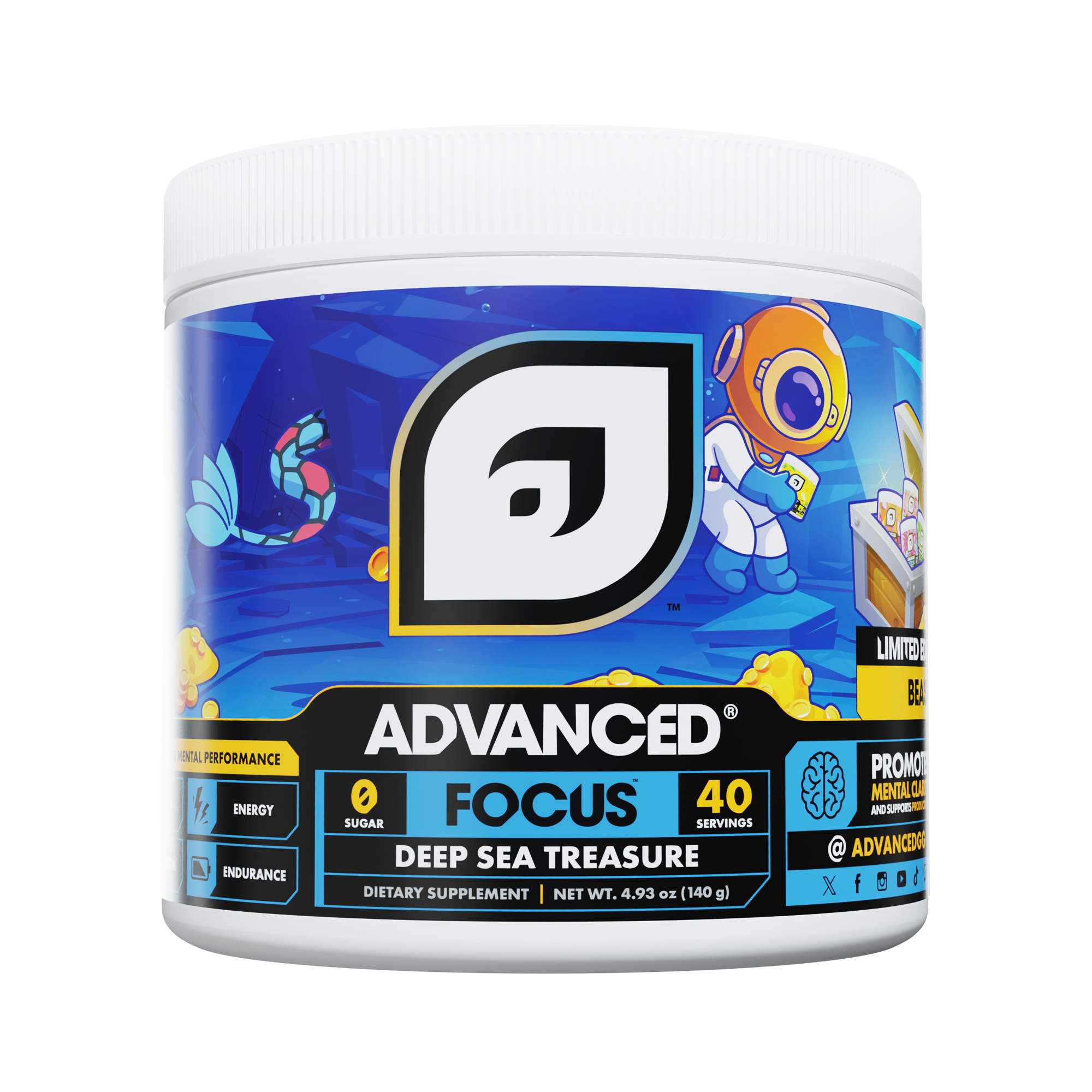
If you'd rather stay off stimulants entirely for part of your session, or you're already caffeinated from earlier in the day, our FOCUS line comes in a caffeine-free version built around L-Arginine HCl, Myo-Inositol, and Alpha GPC, which some streamers use later in a long broadcast once they've already had their caffeine for the day. You can check exact label details for every flavor on our products page, and read verified customer reviews on each product page before you commit to a tub.
Does a brand's Twitch chat mention count mean it's actually the best?
Not necessarily. Chat mention volume mostly reflects sponsorship spend and community visibility, brands like Red Bull and Monster lead by a wide margin because of mass-market ad budgets, not because independent testing shows their formulas outperform gaming-specific brands over a long session. Treat mention data as a popularity signal, not a quality signal.
How much caffeine is too much for an all-day content schedule?
The FDA's general guidance is 400 mg a day for healthy adults, which at a typical 100 to 175 mg per serving works out to roughly two to three servings across a full day, depending on the brand. Because caffeine's half-life is five to six hours, doses taken too close together stack rather than replace each other, which is the more common way people accidentally overshoot on a long stream day.
Is it safe to split a serving across a long stream instead of taking it all at once?
For most healthy adults, splitting a dose, say a half scoop at the start of a stream and a half scoop three to four hours later, is a reasonable way to avoid an early peak-and-crash pattern, and it's one of the practical advantages powder formats have over a fixed-dose can. It doesn't change your total caffeine intake, so the same daily cap still applies either way.
Bottom line
For streaming specifically, prioritize zero sugar, a caffeine dose you can split across hours rather than one you're locked into, and a label you can actually read rather than a mystery blend, since you're likely drinking this on a recurring schedule rather than once. Twitch chat mention counts are a useful signal for what's culturally visible in the space, Red Bull and Monster lead there by a wide margin, but they're not a substitute for checking caffeine dose, sugar content, and serving flexibility against your own multi-hour schedule. Whatever you land on, keep water in the rotation alongside it, especially if your voice is doing as much work as your hands.